|
|

No
other group of ingredients
is more versatile and basic to cooking than the famous member of the
Allium
family - onion.
|
|
| Cultivated
around the world
for over 5,000 years onion is thought to be of central Asian origin.
Onion
was certainly cultivated by the Egyptians as far back as 3200BC, they
made
offerings of onions to their gods, took oats on an onion, they used
onions
as part of the mummification process and depicted the onions frequently
in their tomb paintings. The ancient Egyptians also traded eight tones
of gold to for onions to feed builders of the pyramids. The builders of
the famous pyramids at Giza were reputed to have been paid partly in
onions.
This
well known Allium family
encompasses more than 500 members and most of them are edible, but not
all are good to eat. Famous members of Allium family like green onions
(also called scallions), sweet onions (white, yellow and red
varieties),
dried garlic, fresh garlic, chives, shallots, leeks, pearl onions (also
white, yellow and red varieties), rocambole (sand leek) and many others
are indispensable in countless dishes from soups to salads and are also
a great source of B vitamins, vitamin C, calcium and potassium.
Onions
are incredibly versatile
and each cuisine has its own rules regarding the treatment of onions.
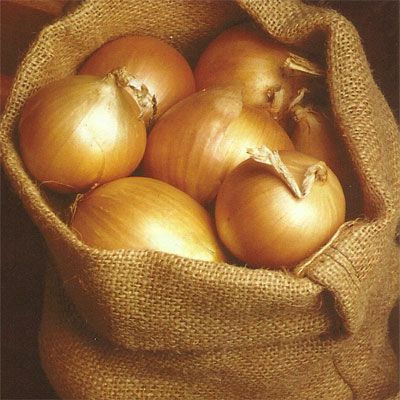
Yellow
onions are the most common cooking onions and have the strongest
flavor.
White onions have a sharp fresh taste and red onions are slightly
milder
and crisper. Leeks are related to both onion and garlic but milder in
taste
and excellent in soups or braised. The flavor of Welsh onions lies
between
leeks and onions. Spanish and Bermuda onions are chrisp, sweet and
mild.
Vidalia, Walla Walla and Maui are super sweet varieties and often eaten
raw. Pearl onions are very small and mild and usually cooked whole in
stews,
pickled or braised. Shallots taste like a cross between a mild onion
and
garlic. Chives have a light onion aroma and spicy onion flavor. Chinese
chives are more garlicky and used in spring rolls, with tofu, eggs or
stir-fried
dishes. Green onions are young onions with long green tops and mild
flavor.
|
|
| Preparation
Tips:
Onions are best chopped by hand, food processors will change their
taste
and texture. Onions lose flavour very quickly, so chop them just before
using. If peeling and chopping onions makes you teary-eyed, try to hold
the onions under cold water as you peel them and rinse the onions in
cold
water then chop. You could also try to place them in the freezer for 20
minutes before peeling. When peeling a pearl onions, soak them for a
minute
or two in boiling water, then rinse under cold water. The skins will
then
slip off easily. |
|
Remove
Odor:
If the
smell of onions on your hands bothers you, try rubbing your hands with
a few drops of lemon juice or vinegar or roll fresh lavender flowers
between
the fingers. If you want to clear your breath, eat some mint, celery
leaves
or a sprig of parsley. |
|
| Buying
and Storing:
Choose onions that are firm, have a crisp, dry skin and no sprouts.
Onions
that feel light for their size may already have started to rot inside.
Store onions in a cool, dry well ventilated and dark place. |
|
| Healing
Properties: Old
folk healers have advocated
onions as a "heart healer" and remedy for hundreds of other medical
conditions
including treatment of infections, wounds, curing baldness and the
common
cold. There is no scientific evidence to support all the claims, but
some
new researchers have now confirmed that an organic compound in onions,
called ADENOSINE, functions as an anticoagulating agent as effective as
aspirin. The other compound ALLICIN, discovered also in all the members
of the Allium family is a powerful antibacterial agent. Furthermore,
scientists
have discovered that sulfur compounds in onions (compounds that are
responsible
for the characteristic onion odor), fight the certain stomach cancers. |
|
| GARLIC |
After
onions, garlic is the most widely used member of Allium species. Used
raw
or cooked, garlic is essential in most cuisines around the world.
The Koreans
hold the record
in consumption per capita, followed by the Southeast Asians, then the
Europeans
around the Mediterranean. |
|
RECIPES TO TRY:
|
 French
Onion Soup French
Onion Soup
Onion
Rings
Onion
Sauce
Garlic
Spread
Leek
and Parsnip Puree
Leek
and Goat Cheese Gratin
Glazed
Pearl Onions
Onions
Alla Veneziana |
|
|
| Email this info to Friend |
|
Browse Pages
|
Breads & Related
Cakes & Related
Cookies
Amazing Pies
Pastries
Puddings
Eggs
Fruit
Rice
Vegetarian
Tasty Dips
Dressings
Soups
& Related
Cooking With Kids
Herbs & Spices
Special Occasion
Miscellaneous
Recommended Products |
|
|
Great Cookbooks
|
|
Learn
to Eat Healthy is not a traditional diet book with strict rules
and limitations. Here you will find great tips and ideas for healthy
cooking and good guidelines to control your health, your eating habits
and your weight without strict dieting rules. You'll discover that
preparing your own food is fun and easy and your healthy diet is
delicious. In fact, the main reason why most of those quick fix diets
will fail you from the start is because they ignore the way normal
people want to live. This book is simply an easy to read and follow
guidebook with over hundred, easy to prepare, healthy, and tasty
recipes
with full nutritional information, and step by step instructions. More... |
|
Garlic,
Garlic, Garlic : More than 200 Exceptional Recipes for the World's Most
Indispensable Ingredient by Linda Griffith, Fred Griffith
 Cover-to-cover
fun, jam-packed
with recipes & garlic lore, this testimony to the power of garlic
is
perfect for all lovers of "the stinking rose." In the past decade,
garlic
consumption has doubled. Garlic is respected not only in gourmet
circles
but in medical circles as well, for scientific studies have found that
it helps lower cholesterol and may ward off colds and even cancer.
Garlic,
Garlic, Garlic is handsomely illustrated, and sidebars throughout
present
garlic powered recipes, profile growers and festivals, give results of
taste tests of more than fifty varieties, and explore the role of
garlic
in movies, songs, literature, offering every serious and zany fact
about
garlic that you'd ever want to know.
Cover-to-cover
fun, jam-packed
with recipes & garlic lore, this testimony to the power of garlic
is
perfect for all lovers of "the stinking rose." In the past decade,
garlic
consumption has doubled. Garlic is respected not only in gourmet
circles
but in medical circles as well, for scientific studies have found that
it helps lower cholesterol and may ward off colds and even cancer.
Garlic,
Garlic, Garlic is handsomely illustrated, and sidebars throughout
present
garlic powered recipes, profile growers and festivals, give results of
taste tests of more than fifty varieties, and explore the role of
garlic
in movies, songs, literature, offering every serious and zany fact
about
garlic that you'd ever want to know. |
|

|
|